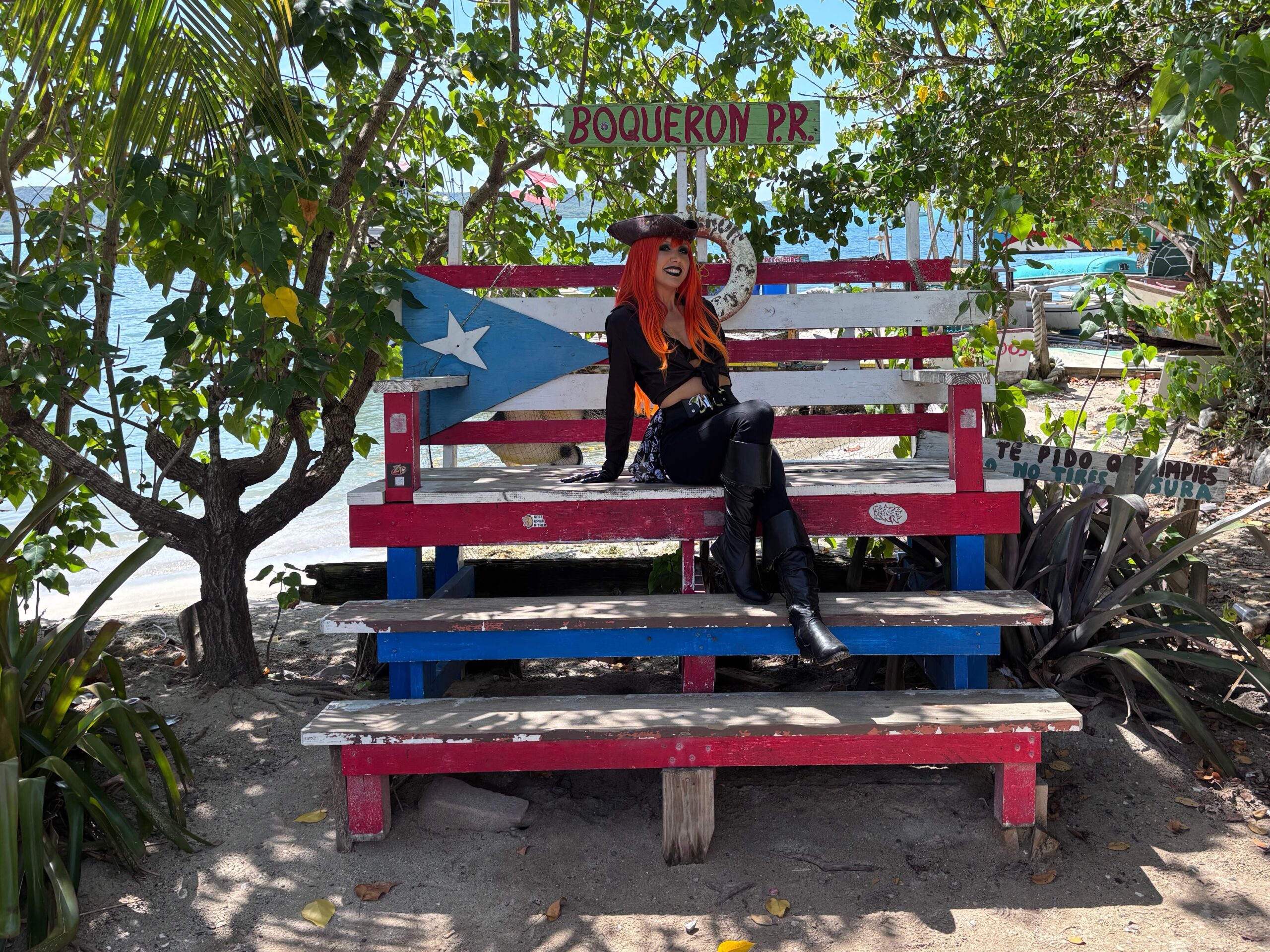
Horror isn’t just an “American” thing — far from it, to be exact. Every country, every region, and every culture has their own versions of horror, with their own monsters and their own ways of delivering frights. But more often than not, there are similarities worth sharing across cultural lines. Melanie Ramos, co-owner of Neo-Pulps! Publishing LLC and horror host “Melevill, the Shadow Demon” of Melevill’s Hades Theater is a prime example of horror bleeding across borders.
As the first native Boricua Horror Hostess, Melanie (or Melevill, as I’ll refer to her), talks about the show, the Neo-Pulps! books, and using her unique Puerto Rican perspective to haunt us all — in English and Spanish!
Origins of Melevill
Tell us about your persona, Melevill, and what you do.
Melevill is a shadow demon, thousands of years old. Her backstory is based on a mix of Jungian philosophy, Greek mythology, psychic vampirism lore, and Puerto Rican urban legends. She’s one of the main characters in what I call my Neo-Pulps! Universe, or the “NPU,” lol. Her main job right now is Horror Hosting, but she’s also been a character actor in old Hollywood and a pirate in the 16th century.
What inspired your creation as Puerto Rico’s first native Boricua horror hostess?
Destroying the stereotype that native Boricuas don’t like horror fiction was probably my biggest inspiration. But Melevill started as a minor character in my yet unpublished Melindra and the Damned syncretic horror series. She was a homage to Vampira, the 1st American Horror Hostess. Horror Hosting was a niche that never became popular in Puerto Rico. I couldn’t even find a Horror Host doing a show in Spanish. That was around 2017, and I was already doing terrible parody videos with my husband. So it was a natural decision, or supernatural, for me to become Melevill. And before I knew it, she had possessed me to dress up and host bad horror movie remakes. That first show was called ‘Melevill’s Nightmare’. Thanks to Hurricane Maria and us not understanding copyright laws, those early episodes are now lost.
You’re a homage to classic horror hosts—what drew you to that vintage format?
I love everything vintage. The more these modern times bring us ‘upgraded’ forms of entertainment, the more I want to go back to antenna TV, where all the late-night shows and movies looked grainy and dreamlike, and to old printed books, where the pages look yellow and smell like dusty libraries. Those older forms of entertainment, like magazines, radio shows, and Public-access television, are more human than anything found in the streaming ‘content’ oversaturating our attention today.
How does being born and raised in Puerto Rico shape Melevill’s voice and presence?
Melevill is definitely the angriest, most confrontational, and sarcastic Horror Host out there. That’s a reflection of the world I grew up in, haha!
We also have our own history, local pop culture, humor, and POVs, which all are greatly influenced by [mainland] US culture — but also by other Hispanic cultures (Mexico, Spain, South America, etc.). Spanish is our first language, which gives us our own slang and a different way of interpreting English. Then there’s the negative side of Puerto Rico: the corruption, hurricanes, gentrification, lack of autonomy, and bigotry that I greatly criticize in my work. But in such a subtle and silly way that most people won’t realize what I’m referencing. But let’s just say that when Melevill fights the AI, she’s not really fighting a robot. She’s fighting a force that wants to replace her and kick her out of her own house. That’s something that all Boricuas can understand.
What does it mean to you to represent Boricua horror on a larger stage?
The most successful horror creators are from the US. If, by some demonic miracle of the algorithm, one of those creators becomes aware of something I’ve created, what I most want them to know is that I am from Puerto Rico. And that, yes, Puerto Rico has many devoted horror fans and talented horror creators waiting to be discovered. Right now, Puerto Rican stereotypes are very popular. On the positive, we’re not invisible to popular media anymore. But on the negative side, stereotypes can overshadow a culture’s original and diverse aspects. For example, Puerto Rico is full of epic pirate lore that most people know little about.


Melevill’s Hades Theater
Melevill’s Hades Theater is described as low-fi and old-school—why was that aesthetic important to you?
The aesthetic of modern entertainment just seems so shiny, corporate, and constricted. It honestly doesn’t feel human. One of the things that attracted me most to horror hosting is knowing that these people were out there, independently dressing up in Halloween costumes and recording themselves in their basements, doing all these bizarre sketches and monologues, not because they were getting paid or seeking fame, but because they loved what they were doing. To entertain whoever watches them was the main goal. That’s the same thing that I love about indie art. It is imperfect, is out of focus, it has typos, but it’s human and created with passion. We love making black-and-white videos or videos that look like VHS. There’s a nostalgic thing to it, but also something that represents entertainment created by people, not machines.
The show pays homage to Vampira. What elements of her legacy speak to you the most?
I could write a whole book about my admiration of Maila Nurmi (Vampira). One of my favorite things, and one that doesn’t get mentioned enough about Vampira, is that she was a satire of conservative 50’s America. Not only did she invent a new form of entertainment at a time when women were not credited for their accomplishments, but she also elevated it.
Horror hosts after her seem like they’re parodying what she invented. And that’s OK, of course. But the idea of this spooky, sarcastic, sexy monster inviting viewers to watch movies with her while she subtly made fun of their culture is what really spoke to me the most.
How do you balance camp, elegance, and darkness in your performances?
I learned how to balance those things by watching the many femmes fatales that dominated film noir. Those women could be evil, insane, and unintentionally hilarious, but they always looked good. They were classy ladies even when murdering their lovers.
You’re filming new episodes in Puerto Rico in Spanish. Do different languages and cultures (other than standard American English) bring something special to the horror genre?
Absolutely. Horror is the best gateway to understanding other cultures. When someone says they don’t like this or that country because they don’t understand their language or don’t have anything in common with their culture, I always ask: ‘Do they understand fear? Good vs Evil? Love? Survival?’ Because all those things are universal. They’re all part of being human. And the best horror creations from around the world always show those things.
Puerto Rican & Hispanic Horror
Puerto Rican horror isn’t always discussed in mainstream spaces—what films or creators do you think deserve more recognition?
Puerto Rican horror creators are almost mythical. They’re out there somewhere, but they’re either hard to find, or once you find them, they won’t reply to your emails, lol. Incredibly, horror fiction is still a taboo subject in Boricua culture. Someone I think deserves much more recognition is the comedian Sunshine Logroño. He’s technically not a pure horror creator. But his horror parodies, like ‘A Boricua Vampire’ and ‘Cafri-Zombies’, are among the best satires Puerto Rico has to offer. I’m also always championing Vampiros (2004) as the greatest Puerto Rican horror film.
Are there specific Puerto Rican legends, folklore, or urban myths that influence your work?
Our obsession with night creatures (Maboya, La Gargola, el Chupacabra, el Jacho, la Llorona, el Payaso de la Guagua, las Sombras) had a big impact on my psyche growing up. I was always hearing about these terrible things happening at night in Puerto Rico. Or that someone saw a shadow that looked like {insert one of those previously mentioned monsters here}. That’s why Melevill is a ‘shadow demon’.
How does Hispanic horror differ in tone or themes from “traditional” American horror?
It depends on the story. ‘Vampiros’ is an independently made Puerto Rican horror film, but it could easily have been made in the US without altering the plot or characters. On the other hand, La Llorona (2019) features themes that specifically address horrible events that happened to the Guatemalan natives, like the Maya genocide. That’s something that Hispanic horror can do really well; it can bring awareness to the horrible events of our past or show that we’re just like everyone else.
What are some must-watch Puerto Rican or Latin American horror films you would recommend to the audience?
Puerto Rican films: Vampiros (2004) and The Condemned (2012). Chille: Eternal Blood (2002). Argentina: Terrified (2017) and When Evil Lurks (2023). Spain: REC (2007). And anything by Guillermo del Toro.
Beyond the Theater
You’re also an actress, writer/director, and publisher—tell us about your other projects!
Psychical media is my number one project right now. What I mean is that I’m planning to create my own DVDs and books without relying on companies like Amazon or YouTube to showcase my art. I want to turn Neo-Pulps! into the type of indie company that could have existed in the late 90s or early 2000s.
You mentioned you were working on a film and a novel series for 2026—can you tease what kind of darkness we can expect?
You can all expect the two Ss… that’s right, Syncretism and Satire, lol. Mixed with pulp horror, of course. With the series and the film, I will finally be able to show just how interconnected all my stories are and that the true DIY spirit is very much alive in 2026.
What does the future of Boricua horror look like to you?
For film, sadly, not good. We have a government that doesn’t support our local talent, and Puerto Rican audiences that need a lot of convincing to support indie productions. For written fiction, I read that many Boricua horror writers are considering publishing their stories in English from now on, as that is the only way they can reach a wider audience or bigger success. The small amount of success that I’ve found has been with my English work. So I understand that. I like to think positively, though. There will be a change soon as more people return to appreciating older forms of entertainment. Boricua horror can definitely find an audience among physical media lovers and the indie DIY scene.
Melevill said it best: if you understand fear in your own culture, you can absolutely relate to fear in another. Melevill and her obsession with creating scares is a shining beacon not only for Puerto Rican horror, but the genre worldwide. Neo-Pulps! and Melevill’s Hades Theater reflect a time gone but certainly not forgotten, and the themes she presents demonstrate what the genre means to us historically, politically, and culturally.
Which is exactly what horror is. It is a way to express our thoughts and feelings as humankind in a way that can be understood by everyone. And through her work, Melevill keeps the nightmares alive through historical context-driven specials, old-school sentiments, and political activism all wrapped up in a terrifyingly Boricua character.
Support Indie and International horror! You can find Neo-Pulps! and Melevill on YouTube, Instagram, their website, and Amazon.