


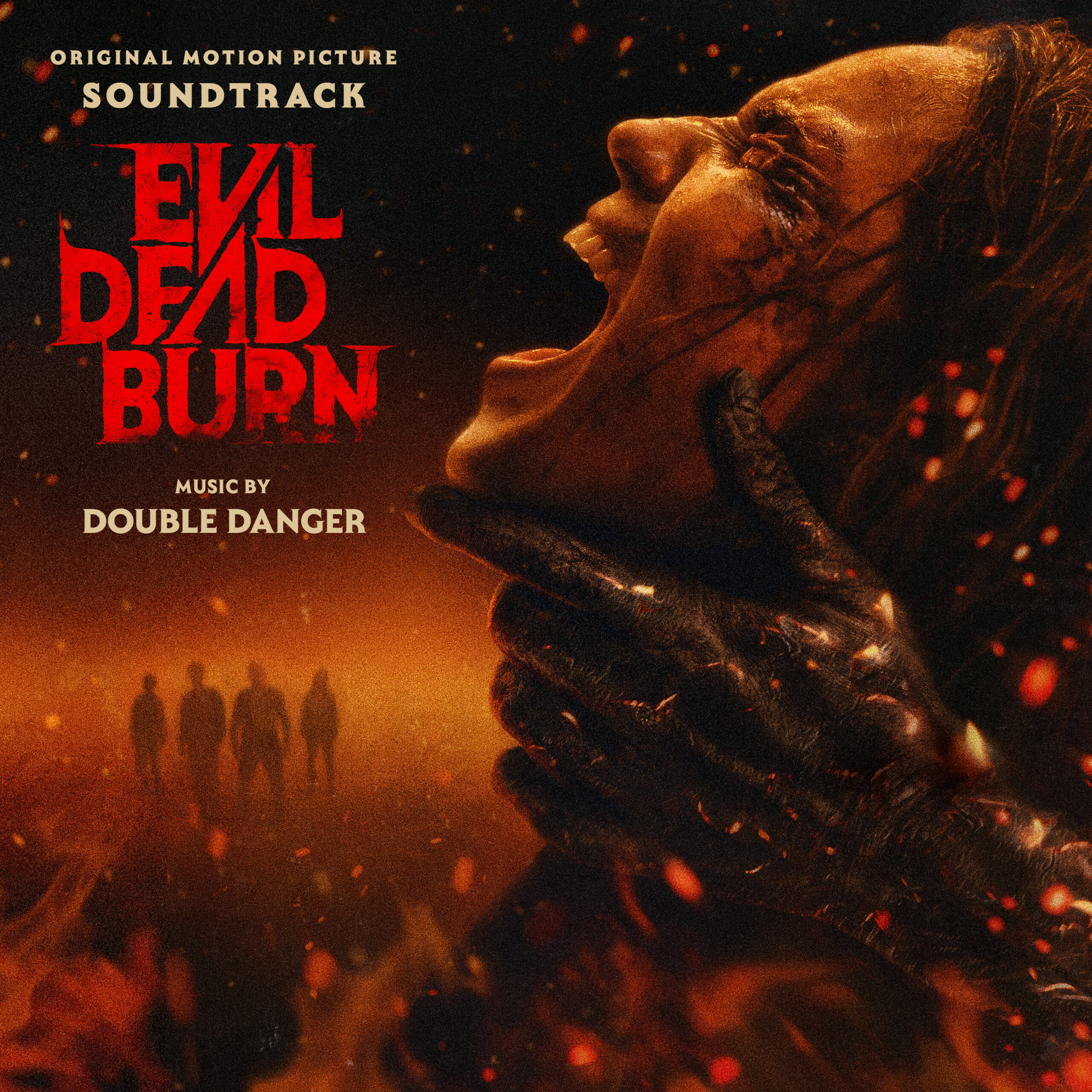
Last October, I had the privilege of speaking with Joe LoDuca, the composer who helped define the iconic sound of the original Evil Dead films, as well as see those songs come to life in a live show. Now, with Evil Dead Burn, a new generation of composers is carrying that legacy forward. I sat down with the duo Double Danger to discuss honoring one of horror’s most recognizable musical identities while creating a terrifying sound all their own.
In preparation for this interview, I grabbed my headphones and pressed play, ready to immerse myself in a world of pure unadulterated evil.
Let’s start with some quickfire questions!
If you had to describe the Evil Dead Burn score in just three words, what would they be?
Burning. Razor-sharp. Alive.
Same question, but for your own music: three words that define Double Danger.
Fearless. Radical. Uncompromising.
What’s one sound that instantly makes your skin crawl?
A human voice that’s been manipulated just enough that you can no longer tell whether it’s still human. We’re fascinated by that kind of sound. Your brain instinctively recognizes the texture of a human voice, yet at the same time it becomes impossible to identify. That ambiguity creates a very deep sense of discomfort.
What non-traditional instrument or object do you enjoy using the most?
Douglas: There’s actually a funny story behind one of the sounds in Evil Dead Burn. Sébastien wanted the Grandfather Joseph Book to have a completely unique sonic identity — something you’d never heard before.
One evening in the studio, Xavier accidentally scraped his metal water bottle across our desk, and it produced this eerie, haunting sound that instantly caught our attention. It almost sounded like the distant voice of a ghost. We immediately looked at each other and said, “That’s it. That’s the Book.“ So we recorded it, and that became the signature sound of the Book throughout the film. Every time it appears on screen, you’re actually hearing Xavier’s water bottle. (laughs)


Entering the World of Evil Dead
What was your first reaction when you found out you’d be composing the score for Evil Dead Burn?
At first, it was pure disbelief. Evil Dead is such an iconic franchise in horror cinema that it almost didn’t feel real. It took us a while to process the fact that we were actually going to contribute to its legacy.
Very quickly, though, that excitement turned into a huge sense of responsibility. We knew fans had high expectations, so our challenge was finding the right balance between honoring the franchise’s legacy while creating something genuinely modern and new.
Joe LoDuca’s music helped define the sound of the franchise. How did you balance paying tribute to his work while creating your own identity?
The last thing we wanted was to imitate Joe LoDuca. Instead, we wanted to understand why his scores worked so well. We spent a lot of time studying that constant feeling of unease, the dissonant harmonies, and the almost ritualistic quality of many of his cues.
When Sam Raimi asked Joe to score the original Evil Dead, the resources available were incredibly limited. The budget was small, and the technology simply wasn’t what it is today. Those constraints pushed him to become extraordinarily inventive, and that’s what gave the original score so much personality.
For us, limitations are a catalyst for creativity. We like to establish strict creative rules from the very beginning and deliberately limit our sonic palette to sounds that genuinely serve the story. We could have gone for a traditional orchestral horror score, but instead we wanted to blend very different musical worlds in unexpected ways.
We recorded a 24-piece choir in North Macedonia, worked with a metal vocalist in our own studio, combined contrabass and violin with a bowed cigar box guitar, and constantly searched for unusual textures that could coexist naturally. In many ways, the process itself was our tribute to Joe LoDuca — that same DIY spirit and willingness to invent something unique rather than relying on convention.
Was there one scene you particularly enjoyed scoring? And one that proved especially challenging?
Scoring the long take sequence was an absolute thrill. Even when we first read the script, we had the feeling it was going to be one of the film’s defining moments from a technical standpoint. What’s particularly exciting is that we actually composed that piece before filming even began. When the editor eventually laid it against the footage, everything clicked almost immediately. It was one of those rare moments where the music and the images seemed to have been made for each other. From there, we just kept refining it, making it more aggressive, more relentless, and completely unforgiving.
Another sequence we loved working on was the entire scene in Polly’s bedroom with Susan and Edgar. Emotionally, it was incredibly dense because every character is experiencing something different at the same time. Finding the right musical balance to support each emotional perspective without overwhelming the scene was a real challenge. Those are exactly the kinds of creative problems we love solving. They force us outside our comfort zone, and although this cue demanded a tremendous amount of work, we’re really proud of the disturbing, haunted atmosphere it creates in the finished film.
How do you decide when the music should warn the audience… and when silence is more effective?
We always try to put ourselves in the audience’s shoes. If the music reveals too much, it can weaken the suspense. Silence, on the other hand, often makes a scene far more uncomfortable because it leaves the audience completely alone with what’s happening on screen.
Ultimately, music and silence serve exactly the same purpose: controlling tension.
Did you experiment with any new sounds or techniques for this film?
Absolutely. One of our biggest areas of exploration was the human voice. We worked with a full choir, several solo vocalists, and even a metal singer whose screams became instruments in their own right. We also experimented extensively with contrabasses tuned as low as physically possible, deliberately saturated orchestral recordings, unconventional bowing techniques, and heavily manipulated acoustic textures. We wanted the score to feel as though it was literally burning apart — as if the music itself were slowly disintegrating.
[ more of the soundtrack available on Spotify ]
Crafting Fear
When you start working on a scene, what comes first: melody, rhythm, texture…?
Almost always the texture. Before writing a single note, we try to understand what the audience should feel. Once we’ve found the right atmosphere, melodic or rhythmic ideas tend to emerge much more naturally. The emotional world of a scene always comes before the music itself.
Do you see music as simply supporting the film, or as a character in its own right?
I think music can absolutely become a character. With Evil Dead Burn, that was actually one of our strongest creative intentions from the very beginning. Together with Sébastien, we wanted to treat the house almost like a living entity — to make it breathe, watch the characters, and gradually tighten its grip on them. Music became one of the primary ways of bringing that idea to life.
Rather than giving the house a traditional musical theme, we wanted to give it a voice. Through the lowest contrabass registers, the choir, and certain breathing-like textures, we wanted the audience to feel that the house was always present, even when it wasn’t the focus of the image. It becomes an invisible presence that silently accompanies every scene, constantly contributing to the growing tension.
Which emotion is the most difficult to express through music?
Probably madness.
Fear already has a well-established musical language. Grief does too. Madness is much more elusive. It requires creating something unstable and unpredictable while remaining emotionally believable. The line between genuine psychological instability and caricature is incredibly thin, so finding that balance is always one of the biggest challenges.
What did it feel like hearing these pieces performed by a real ensemble?
It’s always an incredibly special moment. For months, you’ve been living with mock-ups and imagining what the music might eventually become. Then suddenly, dozens of singers bring those ideas to life, and everything becomes more organic, more alive, more powerful.
That said, we never wanted the score to become a traditional orchestral recording. Every cue combines different sonic materials and contrasting sources. We deliberately avoided the obvious choice of making it a purely orchestral score. Instead, we wanted to dirty the sound — to take these beautifully recorded performances and twist, distort, and reshape them without mercy until they became something far more unique.
After Evil Dead
Looking back at Infested (Vermines) and now Evil Dead Burn, how has your approach to composing evolved?
I think Infested mainly taught us to trust our instincts and to push the conceptual side of our work even further. That score was already heavily driven by textures, organic sounds, and experimentation. Evil Dead Burn simply allowed us to take that philosophy much further while approaching a much more narratively complex film in an even more methodical way.
But our core philosophy hasn’t changed at all: tell an emotional story first, and impress people second.
Has this film changed the way you approach horror scoring?
Absolutely. It reinforced something we already believed: great horror music shouldn’t exist just to scare people. Its job is also to make the characters feel deeply human. The more the audience cares about them, the more devastating the horror becomes when it finally strikes.
We also wanted to make the experience even more immersive — to let the music almost disappear into the image itself. Sébastien approached the film with an incredibly musical sense of rhythm. The editing has a very precise pulse, almost like a piece of music in its own right, so our score had to follow that relentless urgency and the growing sense of claustrophobia that builds throughout the film.
If someone listened to the soundtrack without ever seeing the film, what kind of journey would you hope they experience?
I’d love for them to feel like they’re slowly descending into the depths of hell. (laughs)
It would begin with curiosity, then gradually become more and more unsettling until it feels almost suffocating — while still allowing moments of beauty and genuine emotion to break through along the way. We love the idea that a soundtrack can tell its own story, even without the images.
What do you hope comes next for Double Danger? And are there any directors or franchises you’d dream of working with?
Right now, we’re simply enjoying the fact that Evil Dead Burn is finally being discovered by audiences.
Looking ahead, our biggest hope is simply to keep telling stories through music, regardless of genre. We absolutely love horror, but we’ve never wanted to be defined by a single category.
As for filmmakers, there are many whose work we deeply admire. Directors like Robert Eggers, Ari Aster, and Danny Boyle all give music a central role in their storytelling and filmmaking. Collaborating with artists like them would be incredibly inspiring.


[ Deluxe 2xLP edition soundtrack available for pre-order from Waxwork Records ]
Celia’s Take
Going back to the top of this article, Double Danger‘s Evil Dead Burn soundtrack just felt… right. It fit in so well with the other music of the franchise and in my opinion, was a nice addition to the works of Joe LoDuca’s original universe.
As Double Danger mentioned above, I actually did listen to the soundtrack before ever seeing the film itself. I sat myself down with over-ear headphones and quickly realized that I needed to close the door behind me; it turns out that having your back to an open door while listening to hellish melodies is pretty scary. This all happened within 30 seconds of turning the music on, no less!
As I made my way through the soundtrack, I could visualize the scenes as they happened, feeling the pulsing heartbeat of immense distress worming its way through my core. “Behind Rune and Hex,” “To Your Perfect Family,” and “Boo!” were my standout favorites, as they not only made me fearful, but they added in bits of other emotions — like worry and sadness — making for a well-rounded experience overall. I finished the album feeling pumped, albeit a bit on-edge.
People forget that music has such a big influence on horror movies and whether it will affect you or not. I am the person in the theater covering her ears; my thought is that if I can’t hear it, I’ll be safe. Being that film is such a visual-heavy medium, the sounds that accompany it oftentimes need to do some extreme heavy lifting to match the energy we see on screen, because the music can make or break a movie. For Evil Dead Burn, Double Danger managed to infuse the film with nightmarish noises, inhuman cries for help, and a feeling of unease that slowly morphs into pandemonium. If you can’t make it to the theater to see Evil Dead Burn, you can still experience it through the soundtrack — and I highly recommend you do (with the door closed and in a well-lit area, of course).
Learn more about Double Danger by visiting DoubleDangerMusic.com. Listen to their discography on Spotify, and follow them on Instagram. Evil Dead Burn is now playing in theaters. The Evil Dead Burn Original Motion Picture Soundtrack is also available for pre-order.

This was a really fun read! Great work. I’d love for you to check out my latest work at paraphenatic.com, if you’re interested! Always looking to get some feedback!
Thank you! I’m always up for more review opportunities — send me an email at press@letstalkterror.com