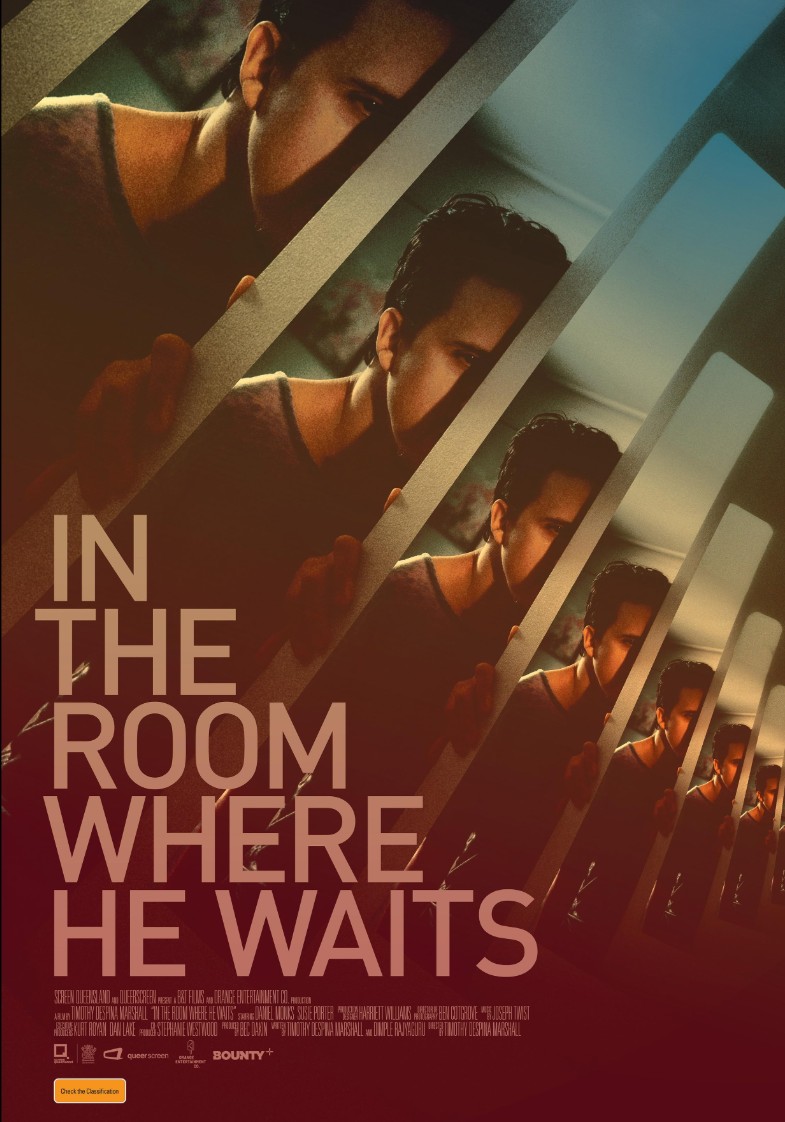
What happens when the ghosts of our past are bigger than the room we’re staying in? Australian queer horror film In the Room Where He Waits explores this concept when a man is forced to confront his darkest emotions while quarantining.
A queer theatre actor waits in a hotel room before his father’s funeral. Convinced there is someone or something in the room with him, he must come face-to-face with all that haunts him, in a fight for his life.
In the Room Where He Waits, IMDB
Disabled actor Tobin checks into a hotel near his hometown in Australia not only to be present for his father’s funeral, but to prep for his big acting break and escape the sadness surrounding a recent breakup. Between rehearsing lines over video calls and chatting up a suitor on Grindr, he is otherwise alone with his thoughts. Trying to overcome boredom and perfect his delivery, he becomes distracted by a shirt, pair of underwear, and cuff links thought to be left by the previous room tenant. That distraction turns into dismay when he notices an unseen presence in the room with him — haunting him. A slow but terrifying decline into paranoia and self doubt threatens to undo all of his hard work.
In the Room Where He Waits is a wonderfully strained slow-burn that doesn’t reveal anything too quickly. It lets the audience wait in the present, begging for an outlet to release their fears and ease their disposition. As we stare into the dark corners of his room trying to find some sort of tangible presence, all we get is a worrisome nothing paired with rising, anxiety-inducing music. And the scares don’t let up at all to a lighter tone; In the Room only switches between uneasiness and helplessness… or perhaps even hopelessness.
When writer/director Timothy Despina Marshall described In the Room Where He Waits, he said the film was “slow-burn, atmospheric psychological horror that explores the darker margins of modern queer life, uniquely framed through the lens of a disabled protagonist. We really wanted to subvert the classic ‘haunted room’ tropes to look at isolation and underlying hyper-vigilance in a very contemporary way,” and I think that’s a pretty important standpoint to make for many reasons. I myself am a cis-het, able-bodied person, and like others, you might wonder how you could possibly relate to Tobin. This is the power of horror: taking the story of an “other” and making it “you.” Tobin deals with emotions we all know and have, but on some level, his stay at the hotel makes his situation much more intense. The themes of isolation, guilt, desperation, and personal failure grow exponentially with each day in his small room. The walls are closing in on him, and he is ultimately trapped.
In the Room does feel like it goes on for some time; just short of 90 minutes, there are points where you feel like the climax and resolution are about to happen, only to realize you’re only halfway through. This could be a pro and con: those wanting more surely get that story extension, but some may wonder how much more could really change the outcome. That said, In the Room‘s tone and energy remain consistent throughout the film, making every scene important. I have to admit that at the end, I was drained (in a good way).
In the Room Where He Waits feels lonely. It feels restless. It feels like an embarrassing moment from your childhood that keeps billowing up and drowning you — but no one else can see it. This film is claustrophobic, and not just in the sense that our main character is in quarantine; In the Room Where He Waits begs the question: is this room haunted, or have our deepest regrets taken control?
In the Room Where He Waits is streaming on Fawsome and Amazon Prime Video (US/Canada/UK and Australia/New Zealand). For more on In the Room Where He Waits, follow the film on Instagram, as well as writer/director Timothy Despina Marshall.