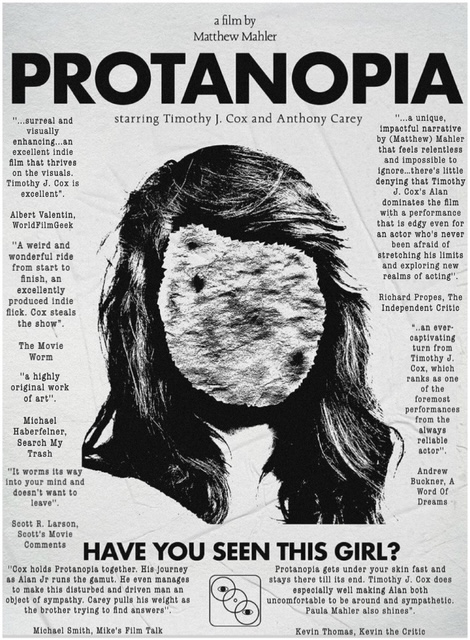
There is something strange about suburbia. Behind the perfectly manicured lawns and nicely dressed front porches lies an evil underbelly that makes people frantic with the thought of keeping up and above of their neighbors. In Protanopia, two men’s lives intertwine because of that haunting power one’s home has over its owners.
After Luke’s sister goes missing, he begins having dreams of a strange house. Unbeknownst to him, that house is owned by Alan Roscoe Jr., passed down to him after the recent death of his father. But something about this house isn’t quite right, and Alan seems to tend to it in strange and disturbing ways.
Protanopia, IMDB
Protanopia dives straight into the deep end with film grain, a ghostly voice over, and a quote from Leviticus’ “Cleansing a Leprous House.” What a way to start a film, bringing us straight into the surrealist horrors about to happen on screen. As the movie drives us down an idyllic street filled with suburban homes, we cut to Luke (Anthony Carey) speaking about his sister’s disappearance to a detective. In that same neighborhood, Alan (Timothy J. Cox) readies his home for the arrival of the Neighborhood Welfare Committee, only to be patronized and emasculated by one of the more “Karen-like” members. Protanopia follows both stories — the search for Luke’s sister and the rise of Alan as a leader — down a rabbit hole of psychedelic yet malevolent happenings, culminating to a finale that highlights the true monster of suburban living.
While Protanopia isn’t exactly analog horror, it certainly feels like it with its fuzzy, grainy texture, awkward and unsettling dialog and movement, glowing light, and dizzying imagery. Some of the sounds used remind me of “true sounds of planetary objects” videos, where blaring instruments feel like a cacophony of anger in your ears; and when these noises play — paired with the red glow coming from Alan’s basement — we know something bad is about to happen.
Something I like about arthouse films is that the intent is not to be popular or make money, it’s purely storytelling, at times, seemingly from the mind of a disturbed individual. Protanopia has points of simple story, but the overarching plot is symbolic in nature and just feels weird. That said, it’s a kind of discomfort that I can’t look away from because the imagery itself is so mesmerizing. As I said at the top of this review, Protanopia does have themes of toxicity and manhood being altered by suburban living — and we do see that — but it’s almost as if those themes are being delivered subliminally through song and voice and light.
And all of that together gives Protanopia this otherworldly feeling that makes me both scared and fascinated. It hits that spot in our primal lizard brain that senses danger, yet remains that beautiful flower we can’t help but fly closer to. Protanopia is a Venus Flytrap, luring us in with a homely tale that hides a monster, trapping us in the suburban Hell that Alan and Luke both live in. You won’t find jumpscares or gore, but you will leave with an uneasy feeling and sudden aversion to cross-hatched grass and homemade pies.
For more on Protanopia, visit the website. Be sure to follow writer/director Matthew Mahler and lead Timothy J. Cox on Instagram.