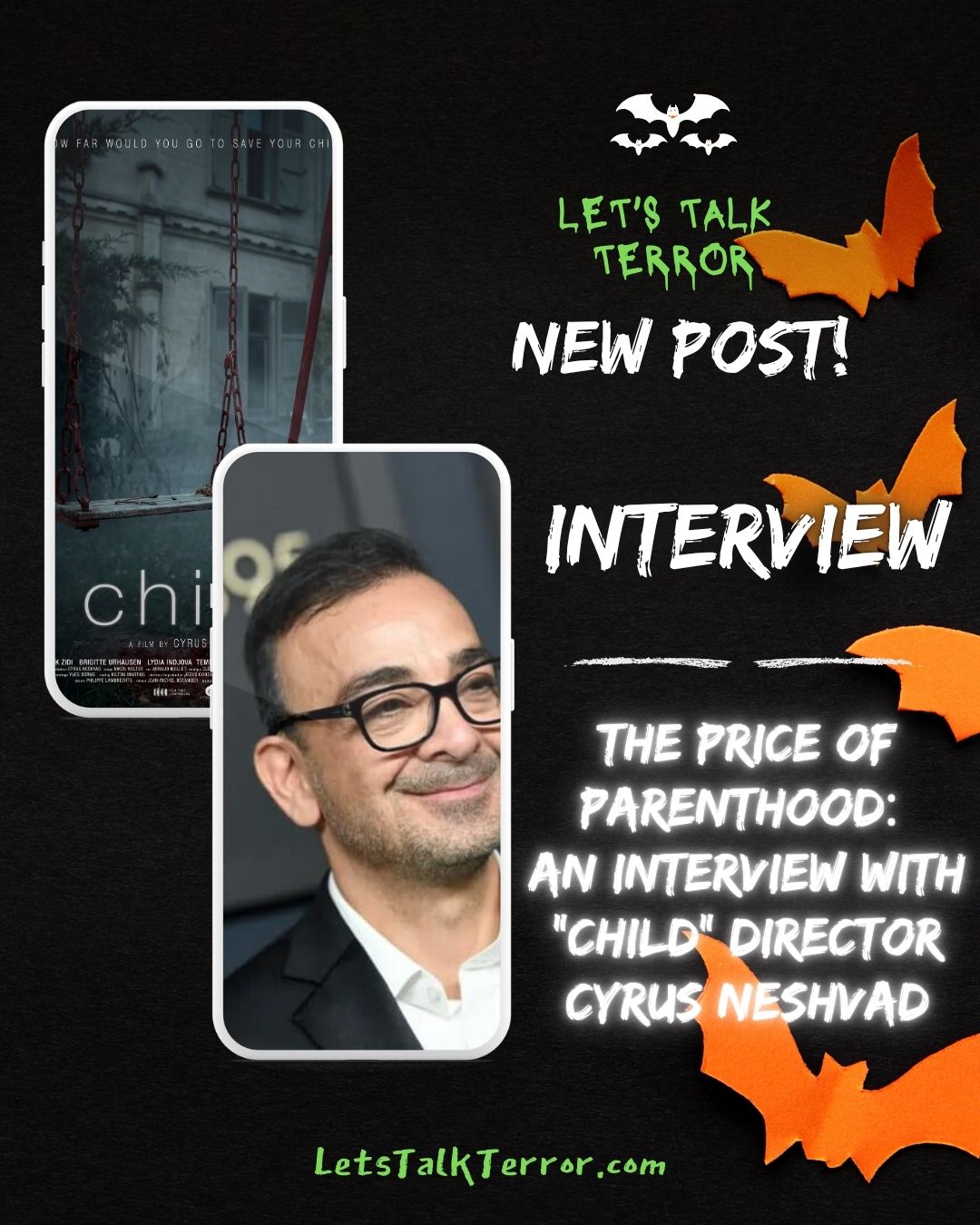
Being a parent makes you do crazy things, think crazy thoughts. You would do anything for your kid — and I mean anything. When I watched CHILD, I was thrown into the depths with grasping just what that meant; would I walk the line of morality to save my own if needed? Does one bond reign over others? Could I live with myself if faced with living without my child?
I sat down with Oscar-nominated director Cyrus Neshvad to gain perspective on the movie and more widely, on parenthood and how far is too far — or not far enough.
Theming
At the heart of CHILD is an incredibly difficult question: how far would you go to save your child? What was the original spark for exploring that particular moral dilemma?
For me, the heart of CHILD is the conflict between morality and instinct. The mother eventually understands that what she has done is unacceptable. As she grows closer to the other mother, she begins to regret her actions and even asks for forgiveness for having taken her daughter’s life. But what interested me most is what happens at the very end. Even after everything she has understood and regretted, in her last breath, her maternal instinct takes over again. She gives the other mother a photograph of her son, asking her to save him. That was the question I wanted to explore: can a parent’s instinct to save their child become stronger than morality itself?
The film puts Anne and Greg in a situation where there really isn’t a “good” choice available to them. How did you approach writing characters who make morally questionable decisions while still allowing the audience to empathize with them?
I asked several couples how far they would go to save their child, and I was surprised by the conversations that followed. Often, the mothers were ready to go all the way, while the fathers were more reluctant. Sometimes I even found myself witnessing couples arguing about it. What struck me was that I could understand both sides. I never felt that one was right and the other was wrong. They were simply responding differently to an impossible situation. That became very important when writing Anne and Greg. I wanted the audience to understand both of them, even when they disagree with the choices they make.
Anne and Greg respond to their circumstances very differently. Greg is consumed by guilt, while Anne becomes increasingly determined and eventually reaches a different kind of “acceptance.” What did you want those contrasting journeys to say about how people process desperation and grief?
It brings me back to this conflict between morality and instinct. There are situations where instinct can take us beyond what we would normally consider acceptable. A mother cat, for example, can sometimes eat some of her newborn kittens when their survival is threatened, allowing the others to survive. It is brutal, but it comes from something deeply instinctive. Greg responds through guilt and morality, while Anne is increasingly driven by something more primal. So perhaps, beneath everything — grief, love, guilt, morality — there is instinct. And in Anne’s case, the instinct to save her child ultimately becomes stronger than everything else.
Your film deals heavily with the ethics of organ harvesting and the value we place on human life. How much research went into developing that aspect of the story, and were there real-world issues that influenced you?
I wanted to stay very close to reality. During my research, I found accounts of gangs kidnapping children and taking organs from children from very poor families, sometimes without anesthesia, or using it only when necessary to keep the child alive. And when it was over, the children were burned to erase all evidence. So I took this as an inspiration for the film and decided to imagine a child who could survive the burning.
I would describe greed and the unfairness of the world as the “real monster” of CHILD. Would you agree or disagree with that interpretation, and why?
We live in a sad world where the rich part of the world thinks it can buy everything it needs from the poor and vulnerable part — even the most precious thing they have: the heart of their children. And the more the rich exploit the poor, the more they create monsters out of them. And one day or another, those monsters will come back for us. If we look closely at the situation in the world today, we can see that this is already happening. It is this horror that pushed me to cross the line into the horror genre with CHILD.


Filmmaking
The film is more of a slow-burn psychological horror than a traditional scare-driven movie. Why was that the right approach for this particular story?
I wanted to make a movie that the audience could accept as something that could really happen. By going too far into traditional scare-driven horror, I felt the audience would distance themselves from the reality of the story. That’s why I begin the film in a very realistic atmosphere and slowly move into horror. Let me give you an example. If somebody falls into boiling water, they will immediately scream in pain and know what is happening. But imagine putting someone in water at a comfortable temperature and then slowly heating it up. At some point, they will burn without even realizing how they got there. That’s what I wanted to do with CHILD: slowly bring the audience into the horror without them noticing exactly when they crossed the line.
How did you and your team go about building that sense of dread throughout the movie?
For me, the audience is scared when they doesn’t know what they are dealing with. They don’t know how to react, and they want to find out what is happening, so they keeps watching very closely even though they are scared. But if the audience knows and sees everything, then they can protect themselves. So I wanted to keep things hidden and let the audience slowly discover what they are dealing with.
The close-ups of Anne and Greg’s faces are particularly effective because we’re forced to sit with their grief, fear, guilt, and exhaustion just as they are experiencing it on-screen. Tell us about the cinematography and what about it made us feel so connected to them?
I pushed my actors to always think about their own children in every scene, to keep them connected to the reality of their own lives and bring that reality into the film. I felt that the more real their emotions were, the more the sense of dread would come naturally.
The film moves through some incredibly atmospheric locations (dusty rooms, dark corners, abandoned spaces, and the burnt, bloodied cave hideouts). What drew you to those environments and how did you scout them?
All the sets emerge from the psyche of the mother. In the beginning, she is a character who has everything under control and planned. So I wanted her to lose this control, and for that I had to bring her into these environments where she would lose control. And by losing control, she slowly finds her humanity.
The ticking clock surrounding the organ adds another layer of tension to the story. Tell us about the choice to put a literal timer on the organ.
The ticking clock first of all gives a sense of urgency to what the couple has to do. But it is also, metaphorically, the heart of the child still beating.
And I kept this idea at the end of the film as well, with the ticking of the girl’s watch. Despite her death, the girl continues to live through the body of the surviving boy.
I really liked the added tension between Anne and Greg in knowing that what they’ve done is wrong and believing that they had no other choice. Do you think morality is absolute, or can desperation change our understanding of right and wrong?
Again, it is all a matter of point of view. I would return the question to you and to the audience: would morality win over instinct if, as a parent, you knew that you might no longer be able to take your child in your arms and tell them that you love them?
Parenthood
Parenthood is such a powerful force throughout the film. What did you want to explore about the ways becoming a parent can change a person’s understanding of sacrifice, responsibility, and fear?
I don’t think we need to be a parent to feel this empathy. It is something deep inside every human being. For me, it comes from our survival instinct — the instinct to protect those we love, sometimes even beyond ourselves.
The film repeatedly puts children at the center of situations created by adults. Was your intention to untimately be a warning to people about consequences being doled out to those they’re taking care of?
Childhood is the purest and most vulnerable moment of a human being’s life. It is the foundation of the person we will become, and we need to protect it the best we can. A child brings us closer to the deepest emotions of love and empathy.
Reception
The First Feature strand at the 2026 Raindance Film Festival brought CHILD to audiences for its world premiere, and the film was nominated for the Discovery Award for Best Debut Feature. What was that experience like for you, particularly seeing the film connect with an audience for the first time?
The most important thing for me was to see the audience react emotionally to the film, whether they were scared or sad. Seeing those emotions for the first time made me feel that the film was connecting with them.
What were some of the biggest challenges of bringing CHILD from the page to the screen, particularly with a story that relies so heavily on atmosphere and emotion?
The challenge was to make the audience believe that what they were seeing was real, and in the same time not losing the horror element. Finding the right balance between these two elements was crucial. What I think keeps the whole movie organically together is that the three stories of these children have the same thing in common: they are all in a basement, fighting for their survival.
Horror can entertain us, but it can also make us confront uncomfortable parts of ourselves and society. What do you think horror can accomplish that another genre might not have been able to accomplish with this story?
It opens a deep scar, which I tend to call a wound, that we keep deep inside ourselves, in a basement. This kind of anxious feeling can only emerge through horror films. In this movie, what is kept prisoner in the basement is ultimately a burnt childhood.
Finally, if you could put Anne and Greg’s central question directly to the audience (“How far would you go to save your child?”), what do you hope viewers find themselves thinking about after the credits roll?
I hope they feel grateful to have their children, and leave the film with the desire to take them in their arms and tell them how much they love them.
The bond between a parent and their child is probably one of the strongest forces out there. It makes sense; children are a living embodiment of yourself and your partner, carrying pieces of your soul wrapped between strands of their DNA. But they’re so much more, a new beginning with their own hopes, dreams, and potential. Neshvad‘s CHILD is the ultimate crossroads with absolutely no gray area; either you will do anything for your child, or you won’t. But under all of these existential ideas brought forth, it isn’t totally about your kid — it’s about you and your bond to others in the same predicament.
There, of course, is no easy answer because parenthood itself is not easy. And CHILD is a somber, painful reminder of that.
Child is playing now in UK cinemas. Read my review here.