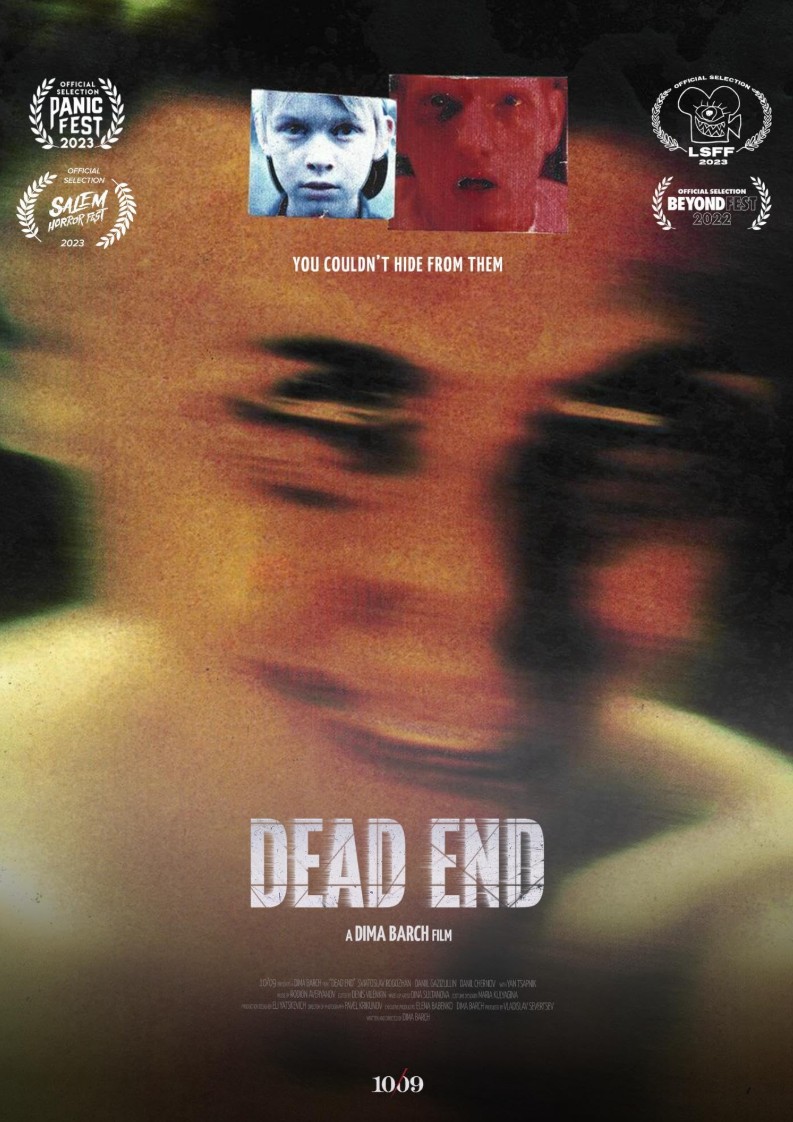
Following up on The Power of the Strike‘s writer/director Dima Barch, we have another short: Dead End. In this short, your supposed wickedness will always find you.
Nick is trying to escape from the house of his spiritually abusive boyfriend Godfrey, who is heavily into bizarre religious practices. The only way to freedom is murder. However, even after his death, Godfrey goes on pursuing Nick.
Dead End, IMDB
A man teaches his unwilling son to shoot a rifle. Flash forward to many years later, where the now-grown boy (Nick, played by Svyatoslav Rogozhan) sits in a bathtub, tormented by degrading voices outside of the door. When he finally leaves the room, he slits the throat of boyfriend Godfrey (Daniil Gazizullin) and escapes — or so he thinks. At every turn, every face is that of his thought-to-be-dead ex, trapping Nick in a nightmare with nowhere to turn to.
As the synopsis describes, Godfrey is shown to be not only mentally abusive (whispering derogatory words through the bathroom door) but physically, as Nick is shown to be wounded. All throughout Dead End, Nick is followed by anger, grief, and self-loathing; his father was overbearing and his boyfriend was worse. And by the end, the madness catches up to him like a lifelong curse, finally killing him. Dead End actually starts off text describing Erinyes, or Roman Furies, beings of the underworld who torture offenders of moral foundations. As Nick is seen to be weak or “soft” — and the fact he is a gay man living in Russia — he is pursued by Godfrey and tormented to the point of exhaustion and eventually, death. As the short states, “evading them was a dead end.” And this rings true because we see that no matter how much Nick fights against his oppressors, he is always overpowered.
While I don’t want to put words in Barch’s mouth, I have the strong inclination that Dead End is a direct equivalent to the LGBTQ+ community in some areas of the world, namely his home country of Russia. While legal, same-sex relationships are frowned upon. In Dead End, we see two distinct representations of discrimination through Nick’s father, and through the church. First, Nick’s father represents the patriarchal society that is Russia, priding itself on manly men who take control of the household and are not softened by things women would do, like having feelings for other men or refusing to learn “manly” activities like shooting or fighting. We also have the Christian/Russian Orthodoxy symbolism shown via crosses. Godfrey and Nick have multiple crosses in their home, and Godfrey is seen in a prayer-like stance opposite of an alter; now this alter hints at some type of dark magic rather than a typical Abrahamic alter (and his voice change as he’s berating Nick is rather demonic), but the sentiment remains the same.
But on the outside, in a very surface-level view, Dead End is an understandable horror movie. Even if we take out the LGBTQ+ aspect, we still have a frightening experience of one person trying desperately to escape another. There is no safe space for Nick; his apartment is stuffy and dingy, the roadside stops are dark and offer no help, and even the peaceful lakeside is the scene of a future attack. It’s like It Follows with a sinister underbelly steeped in political violence against marginalized groups.
Dead End isn’t just a nightmare, it’s a sad ending for many people. Whether they face this sort of terror in real life, or it’s reoccurring mental anguish, Dead End speaks volumes for those seeking the moral high ground — and what happens to those trapped under it.
For more on Dead End, follow writer/director Dima Barch on Instagram.