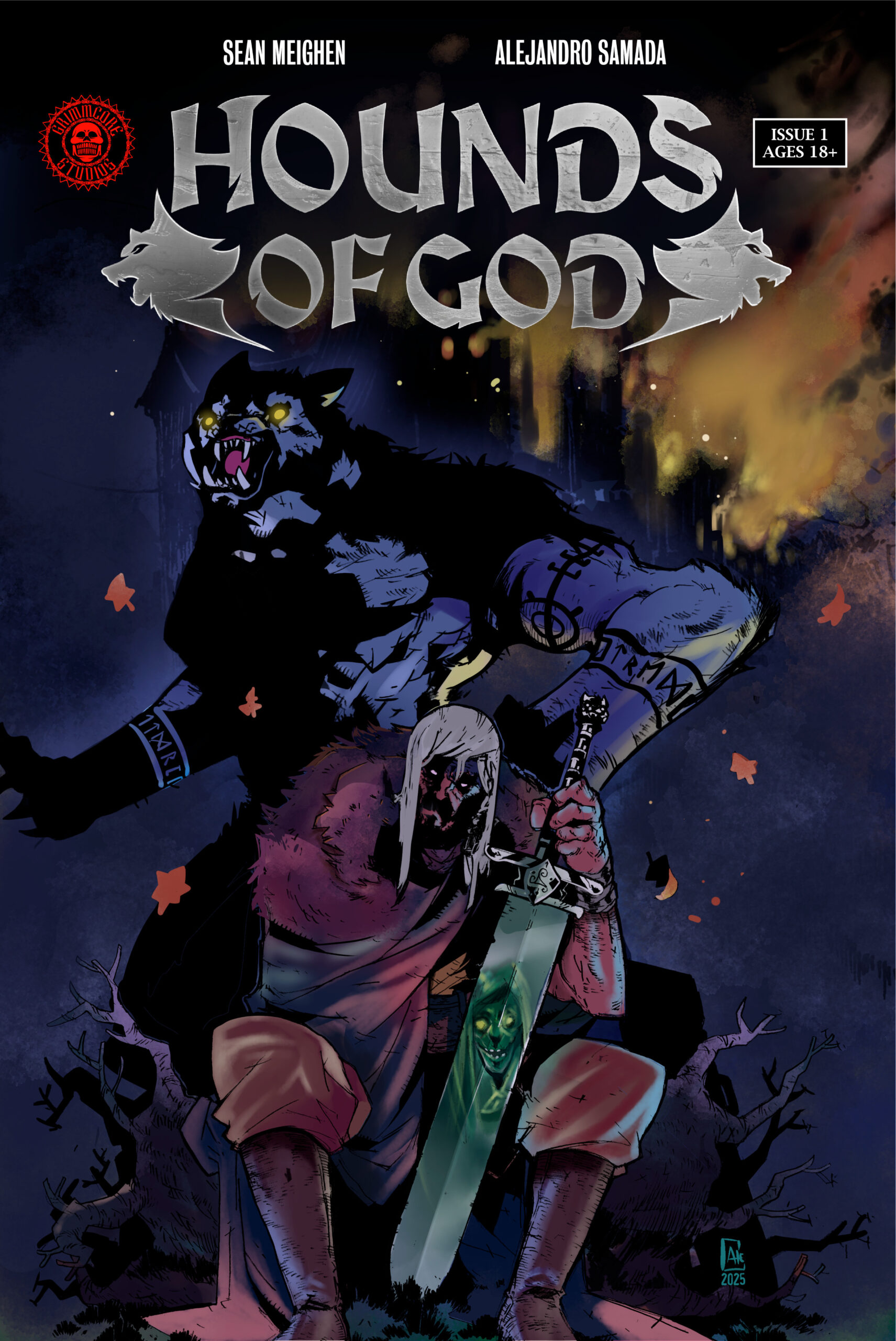
Avid followers of Let’s Talk Terror, you are once again graced with the presence of another Grimmcore Studios project: a dark fantasy horror comic, Hounds of God. If you like werewolves, a medieval setting, tabletop gaming, and heavy metal, you’re going to want to get in on this action.
I sat down with Hounds of God creator, writer, and executive producer Sean Meighen to learn more about this comic masterpiece in the works and how it fits into our real-life tabletop gameplay for those who want to bring the terror to life.
Origins of HOUNDS OF GOD
Where did the initial idea for HOUNDS OF GOD come from — the werewolf warrior, the religious betrayal, or the apocalypse?
The concept definitely sprouted from the idea of a werewolf warrior: a heroic werewolf, as opposed to the villainous ones who are so popular in most forms of media. But it wasn’t until I came up with the religious betrayal angle that the story began to properly develop. As fascinating as a heroic werewolf is, the concept alone wasn’t enough to develop a full story around. But a warrior who has already lost everything, who was betrayed by the very people and institutions he swore to protect? That’s what tied it all together for me.
The concept of holy werewolf knights is kind of a cool twist to typical werewolf mythology. What inspired that take on Lycanthropy?
I first came up with the basic concept years ago when I came across the historical case of Thiess of Kaltenbrun, commonly known as the “Livonian werewolf,” who was accused of being a witch in 1692. During his trial, Thiess claimed he couldn’t possibly be a witch because he was actually a werewolf – a Hound of God – who regularly transformed into a wolf and ventured into Hell in order to fight the actual witches. As you can imagine, the judges didn’t take too kindly to his explanation, and he was supposedly flogged and banished, but the idea of a secret war being waged between righteous werewolves and devilish witches really stuck with me.
Why focus the story on the last surviving Hound rather than the order in its prime?
It raises the stakes. As the last of the Hounds, Kaine has no one else to turn to, no reinforcements to rely on, and absolutely no one else who can swoop in and save him at the last minute. It also forces him to reckon with his legacy and the legacy of the Hounds themselves: will he really let the cause die with him? Will he let his fallen brothers be remembered only as monsters? Or might he find some way to keep at least the spirit of the group alive, if nothing else?
Themes: Faith, Betrayal & Becoming the Beast
The Hounds were once humanity’s protectors — until humanity turned on them. What drew you to that betrayal dynamic?
To paraphrase the Bible, faith untested is no faith at all, and I believe that’s true for a lot of things in life. It’s when we struggle that we learn who we really are. And this story is very much about Kaine struggling. He was betrayed by the very people he swore to protect, and it broke him on a spiritual level. He’s lost his faith, not just in God, but in humanity. So that gives him a very interesting choice: given the opportunity, will he fight for humanity one last time? Or will he let the world burn out of spite?
Kaine is forced to “become the beast again.” Tell us about that storyline of going from one extreme to another.
Kaine is a man who has lost everything: his community, his way of life, even his faith. The Hounds of God were his family, and without them, he is left a broken shell of a man. And then, all of a sudden, he’s called back into action. He’s forced to be the hero again. But there’s still a lot of resentment there, a contempt for the church and the common people who turned their back on him, and that doesn’t just go away. He’s very much a reluctant hero, not because he doesn’t believe he can save the day, but because he’s not sure if the day even deserves to be saved.
There’s a strong undercurrent of religious imagery and corruption. What themes are you exploring through the Inquisition’s purge?
The book is obviously very influenced by Christian iconography, but especially the religious climate of 16th century Europe, which was largely a time of cynicism and upheaval. It’s the age of the witch trials, in the aftermath of the Reformation, when people are really beginning to question their faith and the role of the church for the first time. Superstition is rampant, communities are turning on each other, and everyone fears the Devil is lurking just around the bend. The world is a dark place, breeding monsters, both human and otherwise.
With no church, no orders, and no forgiveness left — what does heroism look like for Kaine? What does he have to gain, and to lose?
Exactly what Kaine is fighting for changes throughout the story, and it’s part of what I enjoy most about him. He’s a complex character. He’s a werewolf, but he believes himself a martyr; he’s divinely ordained, but he regularly curses God for His inaction. So, who (or what) is Kaine really fighting for? Is he doing this for himself, in an attempt at redemption? Is he fighting to honor and preserve the memory of the Hounds of God? Does Kaine even know?


The Witch Mother & Apocalypse
What makes the Witchmother different from a traditional fantasy villain?
Without going too much into her backstory, I can say the Witchmother is every bit as much a victim of persecution as Kaine himself. She’s someone who was grievously wronged by the world, and treated like a monster, so she responded by becoming the worst monster imaginable. But she isn’t doing this just to watch the world burn; she views herself very much as an agent of justice, righting the wrongs done to her and her followers by the corrupt church.
How does her rise reshape the world of HOUNDS OF GOD?
The Witchmother is someone who witnessed the Hounds of God in their prime, as monstrous warriors of God, and now she wants to create her own corrupted version: the Hellhounds. She essentially wants to create an army brutal enough to overthrow the ruling powers of Christendom and bring about Hell on Earth. So, you can see why Kaine might have a problem with that.
Building the Grimmcore Team
How did the collaboration come together with Alejandro Samada, Matheus Huve, Micah Myers, and Daniel Grimm?
I reached out to Dan when all I had was a script, having been attracted to Grimmcore because I was such a huge fan of their flagship book, “The Return of Camazotz,” by Rafael Flores Jr. and Azrael Aguiar. And Dan pretty much took over from there; he is very much the man with the plan. He helped me edit and polish the script, and then put me in touch with both Alejandro and Matheus, who were clearly the perfect guys for the job because they truly brought the book to life with such incredible skill and talent. For letters, turning to Micah was always a no-brainer; he’s a consummate professional, he’s lettered all my previously published works, and he always delivers the goods.
What was most important to you visually when bringing this brutal world to life?
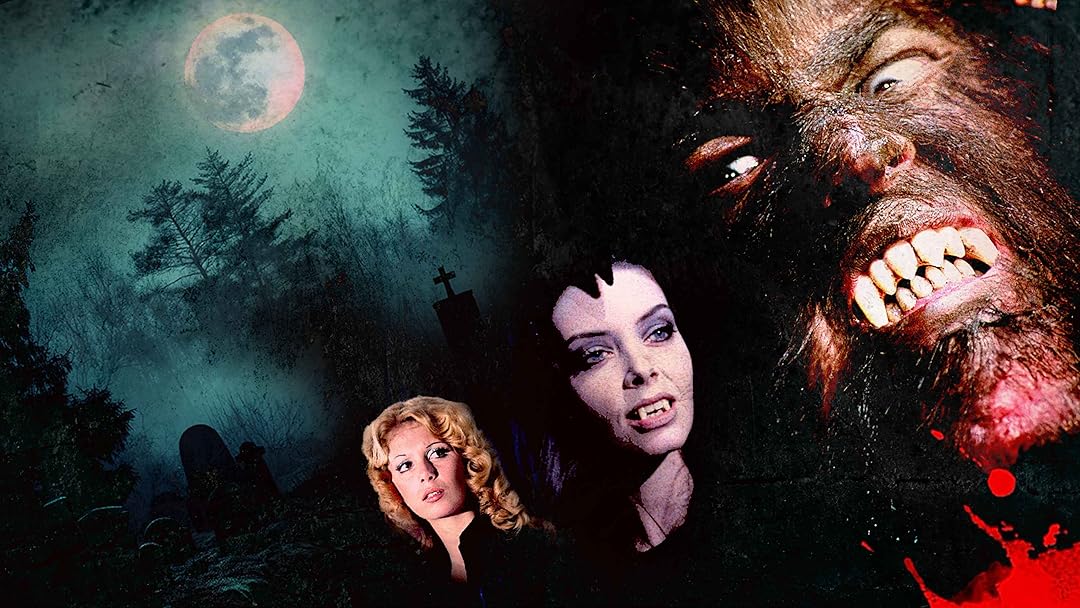
This book is very much a love letter to the old Universal Monster and Hammer Horror films so many of us grew up watching. It’s a Gothic world filled with monsters, witches, and corruption behind every corner. It’s dark, it’s foreboding, it’s violent, and it’s gory. It’s full of fear and ferocity, and Alejandro and Matheus both excelled in bringing that to life.
How do the art and color choices reinforce the savage, apocalyptic tone?
I’ve said it already, but Alejandro and Matheus completely blew me away with their work here. Alejandro’s art is stylized and fierce, with heavy use of shadow and some truly striking shots. And Matheus’s colors really bring it all to life, with deep and vibrant tints that you can practically dive into it. It feels brutal and bright, full of life and death.
Tabletop Integration (5e Class)
Including a 5e-compatible class in each issue is such a bold move — how did that idea come about?
This was all Dan’s idea; as I said before, he’s the man with the plan. I’m familiar with D&D, I have friends who play it regularly, and I’ve rolled the dice a few times myself, but that’s about it. When I first pitched this story to Grimmcore, it was really only with the book itself in mind, but Dan saw something greater, a way to really elevate the tale, to make it more accessible, and to really engage the readers. And I’m obviously all for that!
What kind of player experience are you aiming for with the Hounds of God class?
I see it as an interplay of heroism and brutality. The Hounds of God are akin to paladins in that they are very much heroic warriors of light…but they’re also brutal monsters who rely on tooth and fang to eliminate the bad guys. It’s like fighting fire with fire; to kill a monster, they have to become monsters themselves.
Do you see HOUNDS OF GOD as a larger transmedia world beyond comics?
I think every creator would love to see their story expand to new forms of media, and the 5e-compatible class is clearly our way of testing the waters. I do believe the story itself is structured very cinematically, so that would be an interesting thing to look into. Beyond that, I definitely have some ideas of where future stories could go.


Kickstarter & Just for Funsies
Who is HOUNDS OF GOD perfect for — horror fans, dark fantasy readers, tabletop gamers?
All of the above! I love the supernatural, I love monsters, I love fantasy, I love horror, I love all of it, and I want everyone who also loves those things to take a look, because this book is very much for you!
Favorite werewolf in horror?
I’ll have to go with Lon Chaney Jr.’s tragic portrayal of Larry Talbot as the Wolf Man. No, he doesn’t particularly look all that much like a wolf, but he nails the emotional aspect of it, the brutality, the man living with a curse he cannot hope to free himself from. I’m also a big fan of the 2010 remake with Benicio Del Toro, though apparently no one else was.
Practical fur or full monstrous transformation?
Full monstrous transformation wherever and whenever possible. Transforming shouldn’t be quick and easy; it should be painful and grotesque, full of breaking bones and agonized screams. You don’t transform into a werewolf because you want to, you do it because you have to.
If Kaine had a theme song, what would it sound like?
Slow, methodical, and full of Latin chanting.
Hounds of God brings Middle Ages macabre to the forefront with brutal imagery, dark magic, and a story you’d be hard pressed to forget. Plus, with the addition of TTRPG capability, you can not only hold the comic in your hands, but actually wield its power.
Grimmcore Studios’ HOUNDS OF GOD is crowdfunding now on Kickstarter — contribute now through 31 March 2026! For more, follow Sean and Grimmcore Studios on Instagram.