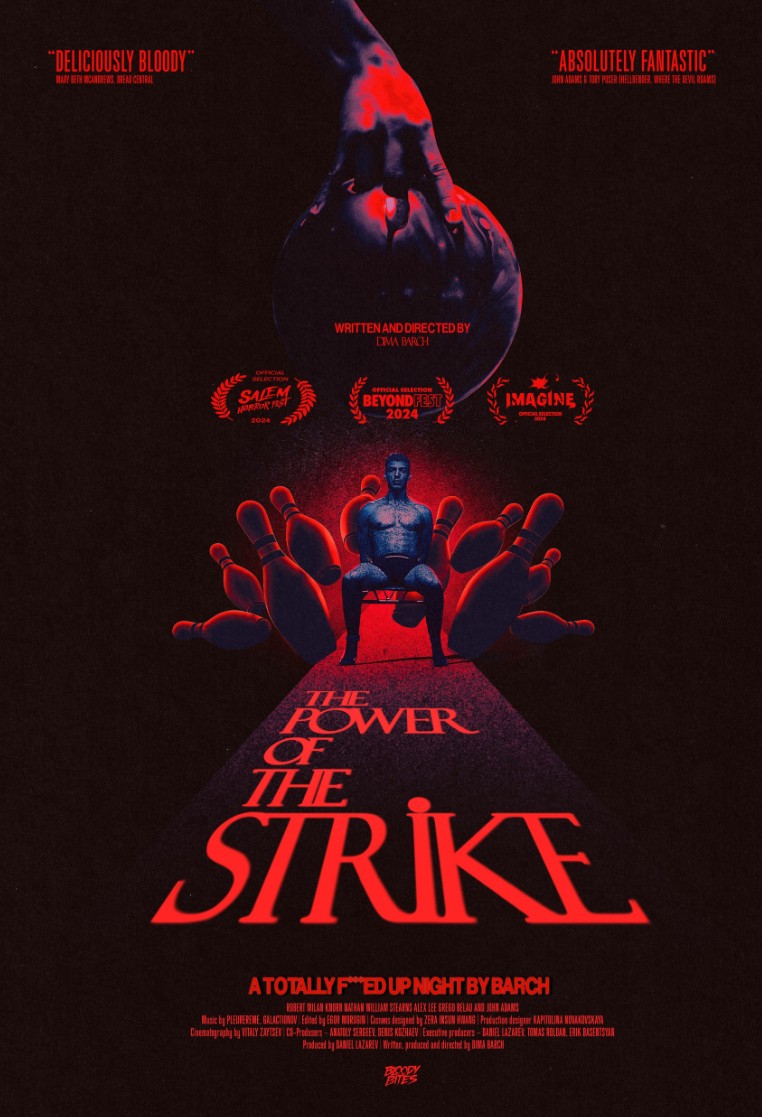
If you told me you could make bowling scary, I would not have believed you. If you said a bowling alley could be seen as an allegory for sexuality, I would also not have believed you. Dima Barch’s The Power of the Strike managed to make that happen.
One totally f***ed up night in a bowling alley.
The Power of the Strike, IMDB
Bathed in red and blue light, a man is forced to commit a murder. Tied up at one end of a bowling lane is former bully (and presumed undercover top) Rick. Wielding a gun and an electrified necklace is Alex, who is shocked every time he disobeys the voice compelling him to pull the trigger. As the neon lights overlay a soft glow over the scene, violent, grimy cuts to Rick on the receiving end of fellacio à la Alex flash on the screen, providing some much-needed background. The voice tells Alex to feel The Power of the Strike, and teach Rick a lesson with the four bullets he has been given.
While the content matter may not be everyone’s cup of tea, I think The Power of the Strike is a multi-level think piece. Let’s compare sex — both hetero and non — to that bowling alley allegory from before. Right off the bat there’s the comparison with genitals (a bowling ball and pins traveling down a long alleyway); a player must propel one phallic symbol down that alleyway, crashing into the other. There is an inherent violence to it, no matter how soft or hard you throw the ball. Both Alex (and as we find out later, the voice) have opposite views on sexuality as well as the actual act of bowling, one having embraced it, and the other, turned to hate.
The Power of the Strike takes you through multiple situations, from the aforementioned bathroom blowjob to the bloodied ball return and even just outside of the building, where two people plot something sinister for no other reason than that they’re homophobic assholes. Looking past the story, you get one part Saw trap and another part survival horror — all under that glorious bi-coded lighting. While I found The Power of the Strike rather simple in plot, I was overly impressed by the look of the whole thing. One scene in particular closes in on Rick and his heaving chest. The tension grows, the voice trods on, and the camera seems to breathe in and out along with him. I’m talking full chest to the screen, pounding so heavily you can pretty much feel the terror as it’s exhaled. That scene was maybe just a few seconds long, but it was done so well that I will remember it for much, much longer. It’s those kind of small details that make independent horror so special — the filmmakers can see on the same level as the audience.
The Power of the Strike is brutal, but that’s how a lot of revenge films are. Sixteen minutes in a bowling alley can teach you a lot about another person: who is accepting, who is willing (or wanting) to fight, and who survives ’til the end. It is short, and there may be some context missing (not that it was necessarily needed), but it’s a start to a much bigger conversation. That is the true Power of the Strike.
Watch The Power of the Strike now on YouTube. Follow writer/director Dima Barch on Instagram.