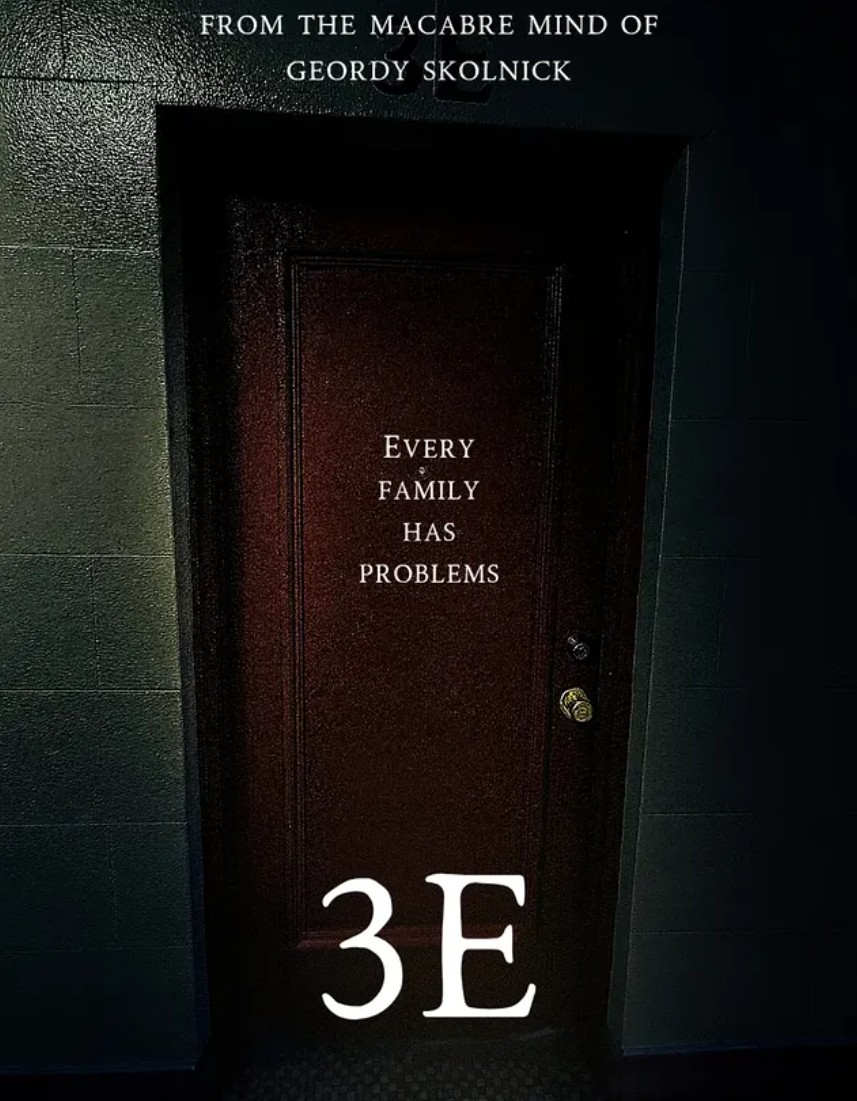
We know writer/director Geordy Skolnick from previous reviews on Madame Dietrich and The Mask: Gone Viral, two delightful renditions of independent horror. Skolnick’s upcoming film, 3E, focuses on more psychological aspect of the genre that takes past traumas and places fear in the family home.
Some apartments hold memories.
Laughing Hearse Entertainment
Apartment 3E holds something else.
I sat down with Skolnick to hear about this Bronx-based tale that creates an emotional dilemma with frightening consequences. 3E is a slow burn trip down memory lane, begging you to question how decades-long horrors manifest in one family.
Origins & Inspiration
3E is rooted in real emotional experiences rather than supernatural horror—what personal or observed moments sparked the idea for this film?
I was actually just talking with my cinematographer about this during a recent meeting, as we were unpacking the different layers of the film. We both agreed that the real horror comes from truth more than exaggeration. For me, 3E is semi autobiographical, more than any film I’ve made before. It was inspired by the death of my grandmother, but also by a very dark period in my twenties when I hit a real crossroads in my life. I was dealing with a lot at the time, and while that moment could have gone in a very different direction, it ultimately saved my life. That lived experience is what shaped the emotional core of the film.
The crowdfunder asks, “What happened inside Apartment 3E?” Why was that question more powerful to you than providing clear answers?
A lot of things in life, I’ve grown to realize, come with more questions than answers. They remain open ended and ambiguous, and sometimes it is frustrating or even painful to accept that we do not always get closure or have the information needed to neatly close a book and say this is the reason for everything. With this film, there is meaning and there are answers, but there are also questions. In this story, you are seeing the visions, darkness, emotion, and sadness exactly as they exist for the characters themselves. You are a fly on the wall, seeing only what they see, no more and no less. It was very important to us that we did not spoon feed the audience and that they experience the film exactly as intended.
Why did an apartment, specifically one space over decades, feel like the right vessel for this story?
Great question. With this film, and just based on my own beliefs, an apartment holds something more spiritually. A house is larger, higher, and comes with land and space to breathe. There is room for things to disperse. This apartment is small, almost tomb like, and over time it collects remnants of the past. With decades of lived experiences layered into one confined space, it gathers emotional residue. That accumulation builds and builds until the cup eventually reaches its fullness, creating a suffocating and inescapable environment that felt essential to this story.
How did documented accounts from Bronx households shape the emotional reality of the film?
Growing up in the Bronx, regardless of the fun times and experiences that come with it, I can honestly say I never felt in danger or pulled into a rough crowd. I kept to myself, and the neighborhood really looked out for me. There was a lot of mutual respect, and that sense of community still exists for me today. When it came to shaping the emotional reality of the film, Bronx households played a huge role. We aimed for a tremendous level of authenticity in the home life portrayed, drawing from people I grew up with, people I knew personally, people I heard stories about, and people I encountered along the way. Many of them were simply trying to live. They might not have been wealthy, and they may have gone through a lot, but they put food on the table and carried a depth and meaning shaped by the scars and weight they lived with.
Story & Themes
Miles returns to 3E after his grandmother’s passing, how does grief act as the entry point for the horror?
They say when a person goes through grief, trauma, or depression, it leaves the mind and body open. With this film being rooted in grief, that openness becomes a crucial entry point for the darkness that follows. Grief plays a central role in this story and stays hand in hand with the characters and everything they are experiencing. A lot of us grieve even without losing someone. The spirit of the film, I would say, is grief from start to finish. Much like many spiritual or paranormal experiences, these moments often surface during emotional low points, when the mind, body, and spirit are vulnerable. In 3E, that vulnerability allows other things to seep in.
The film explores generational silence and emotional inheritance. Why were those ideas central to the story you wanted to tell?
Family has many layers. On the surface, it is often presented as love, unity, and the idea that every family fights but ultimately cares for one another. What interested me was the deeper layer, the things no one talks about. That silence provides much of the depth and meaning behind what family really is and where it is heading. A lot of people from earlier generations were taught not to show or tell, to stay quiet and carry on, especially with the mindset that others had it worse. Emotional expression or seeking resolution often felt taboo. Many families carry that weight. I do not know if burden is the right word, but it is weight. Breaking away from that cycle or confronting generational trauma is difficult. There is often a desire to be more than what came before, and this film shows both sides of that struggle. One side wants to leave it behind and grow, while the other tries to break the silence and fails. Some are simply doomed to repeat the sins of the past.
Apartment 3E feels almost sentient without being overtly supernatural, how did you approach making the space feel alive?
I approached the space of the film as something tied closely to memory and to what feels normal to the characters within that environment. A lot of truly terrifying, real life paranormal or unsettling experiences are not loud or over the top. They are subtle, slow paced, and often blink and you miss it moments. The kind of things where someone might say you would not believe me if I told you. The film is not overly supernatural because real life darkness usually is not. It is the small interruptions to a normal existence that change you forever. That does not make them minor or insignificant. They are brief but unforgettable. Authenticity was crucial, and authenticity in the characters mattered even more. We never wanted the space or the performances to feel forced or like they were trying too hard.
How did your visual and tonal choices help inform the mood without overpowering the film’s personal voice?
A lot of my films have traditionally carried layers of comedy and surrealism. With 3E, this film stands on its own in the sense that you are seeing only what is presented in front of you. If there is symbolism, it is something the characters themselves reveal through their experiences. They want to be seen for who they are. Visually, there are fades, grain, and lighting choices in this film that we have never used in any of our previous projects. While the concept may be heightened and the writing inspired by real life experiences, it was important to step away from the Laughing Hearse tendencies toward slapstick, outrageous content, or overt comedy and allow the film to breathe on its own terms. Some people may see this as off brand, while others may see it as perfectly aligned with our evolution. What ultimately comes through is a clearer, more focused voice than anything we have done before.
Why Now & What’s Next
You’ve said 3E couldn’t be rushed, what told you the timing finally felt right?
It has been about ten years since I woke up from what I would describe as an emotional coma. I was going through a lot of painful experiences, and even after stepping away from that period, you still carry pieces of it with you. For a long time, I wanted to tell a story like this, but I did not feel ready. I did not feel prepared in terms of what I could bring emotionally, how to manage the time and schedule, or whether I had the experience to do it justice. There was almost a sense of unworthiness. Now, I feel ready. I feel capable of honoring the story in the way it deserves.
How did emotional readiness factor into casting and assembling the crew?
Emotional readiness was everything. We took a substantial amount of time casting and assembling the team for this film. About ninety five percent of the cast and crew are new to a Laughing Hearse Entertainment production, which was surprising but also made complete sense. We were looking for something very specific and very honest. We did not want overacting. We needed people who felt seasoned in life, in the sense that you could tell they had been through something and could bring real depth and strength to the material. These were people unafraid to explore darkness or engage in complicated conversations. Everyone involved brought something unique, an it factor that is hard to define but immediately recognizable. We reviewed thousands of submissions and resumes, and ultimately this group stood out as the right people to tell this story.
What do you hope audiences sit with after the film ends?
I want audiences to feel that it is okay for life to not be okay. If anything, this story shows the darkness within family life and how very little in life is truly black and white. It speaks to the human condition of those who are suffering, those who have suffered, and those whose suffering we may never fully see. The pain and darkness of humanity are often what give us strength and meaning, and darkness is what defines the existence of light. Without darkness, there is no light. If I want audiences to leave the film with anything, it is the understanding that family is not perfect, that we are all hurting in some way, and that sometimes the answers we are looking for live in the past.
What happens after 3E, more emotional horror, or something else?
3E was always intended to be a standalone film. There was never any thought of continuing the story, so in that sense, this is very much a one and done experience. That said, making this film did open something up for me creatively. It left emotional horror on the table in a way that I did not expect, and I would be lying if I said it did not make me want to explore more of that space as a filmmaker. Will there be more emotional horror? Probably. But as a writer, I tend to follow inspiration wherever it leads. That could mean returning to this kind of storytelling, or it could mean doing something completely different and even crazier. You never really know.
If you want to know what really happened inside apartment 3E, check out the Crowdfundr and help make this nightmare a reality. For more news and updates, follow 3E, Geordy Skolnick, and Laughing Hearse Entertainment on Instagram.