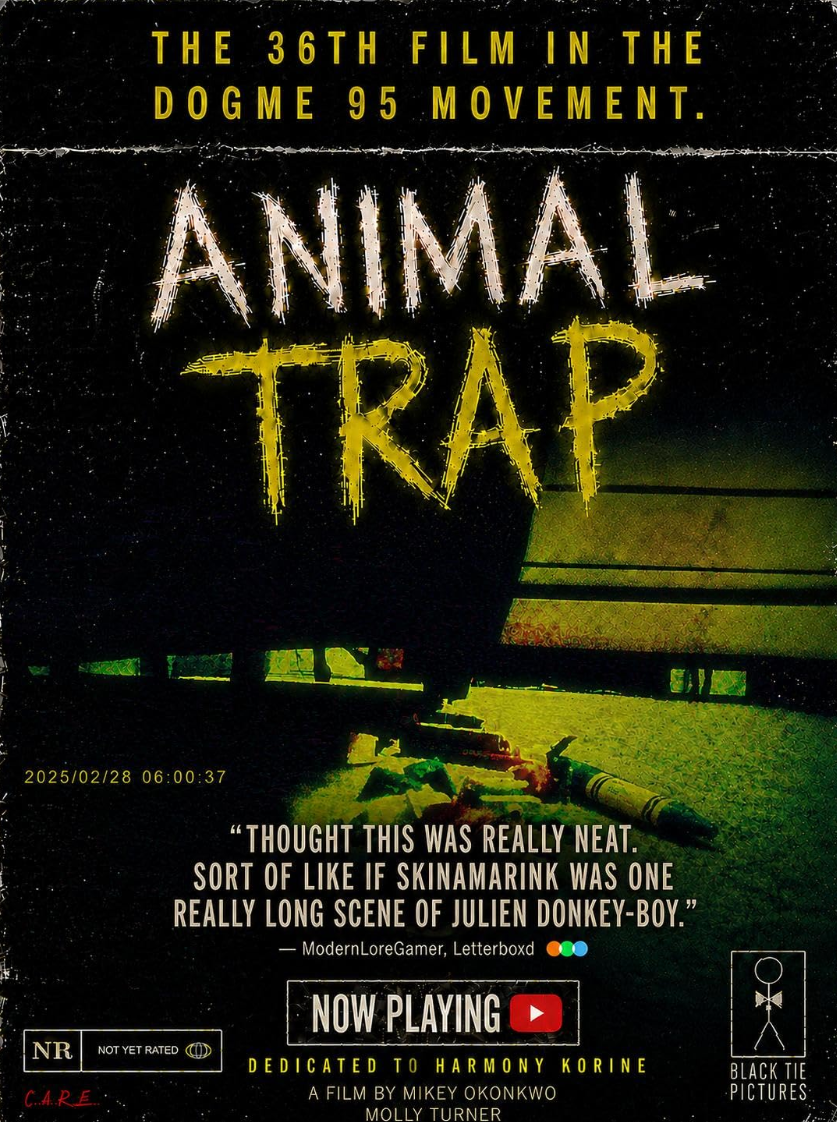
Twenty-seven dollars will get you an entry into the avant-garde scene, as is the case with Mikey Okonwo’s low budget liminal horror feature, Animal Trap.
A young woman is abducted and held captive inside a liminal room where she is trained to regress back into her primal, animalistic nature.
Animal Trap, IMDB
A woman is trapped in a bedroom being filmed. She has no way out and paces around, slowly losing her mind. Animal Trap is an artistic representation of liminal horror and how confinement while being watched can slowly mess with a person. With heavy filters giving a blown-out look with distorted coloring, we join this woman in her spiral downward as she tries to escape.
Now, Animal Trap is definitely not for everyone. Like some arthouse movies I have reviewed in the past, films like this feel more like a movement rather than something to be enjoyed. Animal Trap makes you a voyeur looking at something akin to torture. Without knowing who this woman is or why she’s put in this situation, there’s no way we can prove she’s in good hands… which clearly she isn’t seeing as she visibly grows more insane — and she knows she’s being watched. Instead, Animal Trap pushes the boundaries of what film is and what it can be used for.
That’s not to say Animal Trap is inherently good or bad, though. Through this movie, I’ve been introduced to the concept of Dogme 95, a movement based on giving control back to filmmakers through basing their work on traditional artistic values, for example: filming only on location with sounds and props coming solely from that space, or excluding the use of filters and computer effects. Okonkwo boldly claims Animal Trap continues this movement, however there are definitely “rules” that have been broken in terms of music, director identification, and filtering.
That said — without me being a total expert on the movement and only a fleeting visitor to the world of avant-garde and arthouse films — I think that although Animal Trap doesn’t fit into the Dogme 95 movement completely, it can stand next to it. Perhaps it can even become its own movement entirely. Animal Trap‘s liminal setting is unsettling, and its coloring creates this eerie feeling that definitely feels “found footage.” As for sound, I did notice a few of the music beats and themes repeating, however the in-camera noises wriggled into my ears in a way that made my heart race. It can at times be hard to watch or follow with mumbled voices and ultra-overprocessed visuals, but I think watching with headphones in a darkened room helps somewhat.
Animal Trap is 78 minutes of discombobulation, 78 minutes of endless questions, but mostly, 78 minutes of thought exercises and determining what film is meant for. Animal Trap tells a story, but leaves parts for you to fill in. It allows you to be present in and experience something we normally would not want to see: one regressing into a shell of their former self. The opening quote from Walt Disney (“There’s nothing funnier than the human animal.”) says it all — even the darkest human moments can be funny if looked at through the right lens. And in Animal Trap, “funny” can mean two very different things.
I wouldn’t say that Animal Trap is my favorite movie ever, but as someone who watches horror films for a living, a quick trip outside of my comfort zone always results in learning something new, or seeing something I would never have realized was there in the first place. As I said before, Animal Trap is not the movie to watch for fun or with a group of friends, but it is one that can be seen as experimental or a break into the underground film scene. Of course you want to enjoy all of the films you watch; it is important to also widen your mind’s eye.
Watch Animal Trap on the Black Tie Pictures YouTube channel.