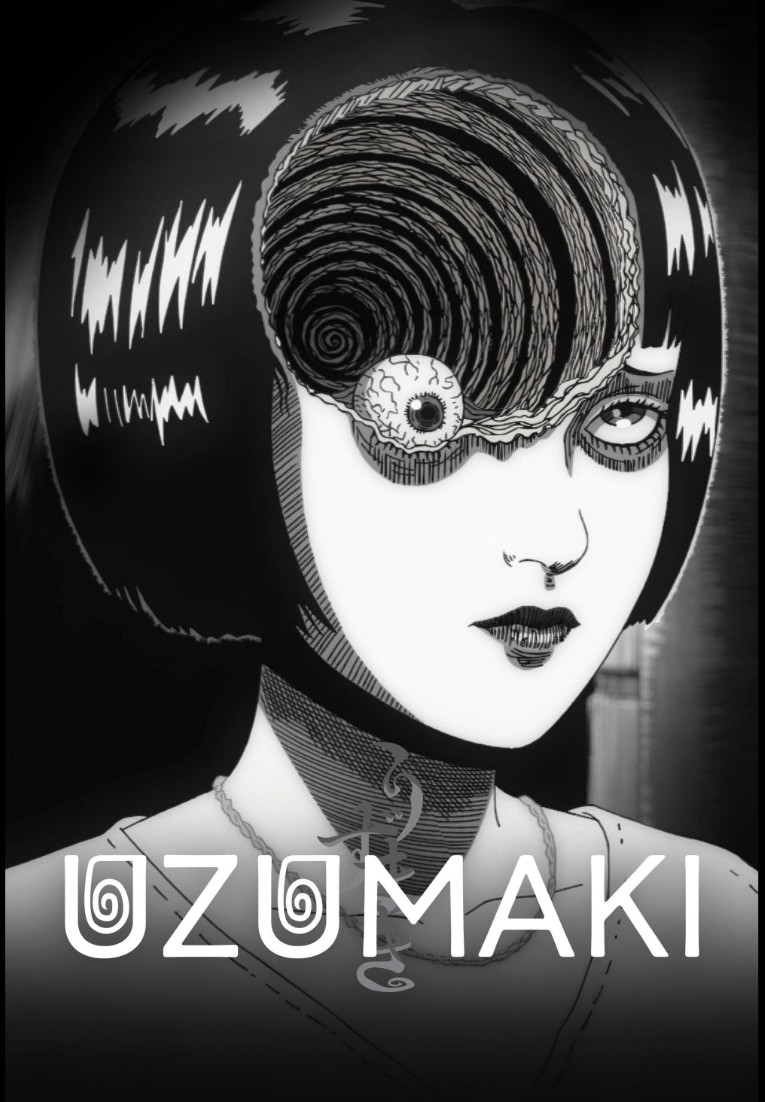
Today is one of my favorite author’s birthdays: Junji Ito. Japanese horror mangaka with an eye for the disturbing, Ito is author to works like Tomie, The Liminal Zone, Soichi, Gyo, No Longer Human, and of course, Uzumaki. Uzumaki (meaning “spiral,” “whirlpool,” or “vortex” in Japanese), was my first introduction to Ito’s work, and it certainly won’t be the last. After reading, I only wanted to consume more, just as the spirals in this story do to a small town in the Japanese countryside. Since its original three-volume series debut in 1998, Uzumaki transformed from words on a page to a movie and most recently, a four-part series on Adult Swim. For whatever reason, the anime just didn’t sit well with audiences; for me, this was a welcome addition to my now-spiraling brain of Ito-centered media.
Hair twisting, bodies intertwining, and spirals are developing all over the town of Kurouzu.
Uzumaki, IMDB
Kirie and her boyfriend Shuichi live in Kurouzu. Shuichi’s father Toshio requests a piece of pottery with a spiral pattern be made, jump-starting the descent into madness that Toshio — then the whole town — fall into. Toshio becomes obsessed with spirals, seeing them in his food, in the sky, and in every living thing around Kurouzu. The spiral addiction spreads amongst members of the town, soon reaching Shuichi’s mom, Kirie’s classmates, and others. As the city is consumed by spiral fanaticism, nothing is safe and the town becomes cut off from the outside world. The spirals have finally taken over, prompting a transformation of all the townsfolk into an abolination from which no one can escape. The spiraling cycle ends and starts again… just as it always has.
As I was researching some of the reasons people generally disliked the Uzumaki adaptation, things like pacing, animation quality, and scheduling came up. While I can’t say much about the scheduling (besides the normal “studios taking too long to make new seasons/episodes”), I can flat-out disagree with the animation style being an issue. This isn’t a regular anime where we have brilliantly-colored, fast-paced, striking action scenes; it’s a recreation of a manga. So for me, subtlety is key, because it should resemble reading the panels of a book. Swirling cloud formations and sticky snail-heads still looked slick and twisted, just as they had in the book. Uzumaki had an eerie quality that oozed worry and let you focus on the story itself, rather than a mash-up of pretty colors thrown up on the screen. It is quintessentially Japanese.
On that same note, the pacing felt appropriate as well. Uzumaki‘s manga form is roughly 650 pages, which was broken up as four episodes in the series. It is a quick watch at 20 minutes each.
- Episode 1: Introduction to characters, Toshio’s descent into madness.
- Episode 2: The spirals affect classmates and people around town.
- Episode 3: Spirals come too close to home, widespread destruction of the town, and spirals on a microscopic level.
- Episode 4: The curse engulfs everything, Kirie and Shuichi see the end result.
I am an avid Ito reader, and I finished Uzumaki in a pretty short amount of time. There will always be an issue with taking a written story and transforming it onto screen, simply because there are plot points that will never be able to make that transition, be it inner dialogue or fantastical scenes. Considering Uzumaki is animated, one of those issues just doesn’t exist. The story as a whole fits well into four episodes, regardless of the 20-minute timing.
For me, Uzumaki was a perfect companion piece to the manga — and dare I say, a better adaptation than its 2000 live-action movie. For those wanting a quick recap and feel of the manga, Uzumaki is it. I appreciated the quite, subtle, and simple aesthetic that still sets an uncanny, supernatural atmosphere for the whole story. In a world where manga adaptations are loud and fast-paced, Uzumaki sets itself apart not just in story, but in feel. Like Ito’s work as a whole, the horrors are just too beautiful to look away.
Uzumaki is streaming now on HBO Max.